
Written by Anupriya Dasgupta, answers by Lou Mier
As part of a new series on our science communication blog we asked some Behavioural Science Research Master students about their major thesis projects. Lou Mier is a second-year student working with the Experimental Psychopathology and Affective Neuroscience group on a project aimed at helping crisis-responding police officers regulate stress. Here’s what we learnt.
What is your project and how and where does it fit into the larger discipline of behavioural science?
When under acute stressful situations, the body defaults to fight-flight-freeze reactions, impairing cognitive control by affecting the autonomic nervous system (ANS). This reduces executive functioning. If the autonomous nervous system cannot restore to a healthy state, this can lead to long-term stress complaints and can result in the development of post-traumatic stress disorder (PTSD).
Heart-rate variability (HRV) is a sophisticated measure of the variation in time between each heartbeat, and a higher HRV signals good autonomic nervous system health, better fitness, and overall physiological health. Higher HRV can mean better stress resilience.
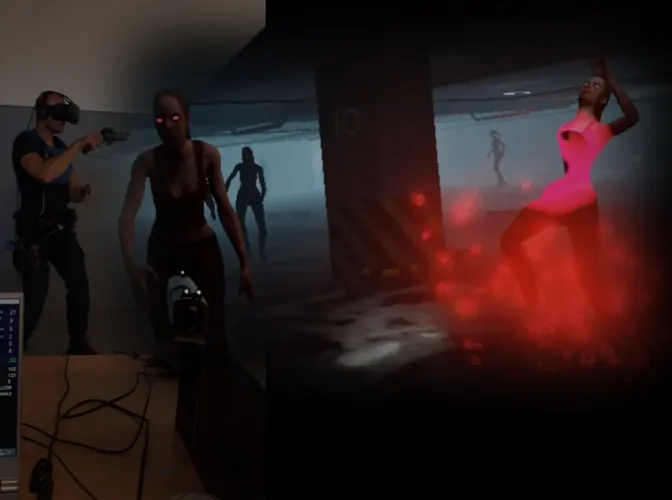
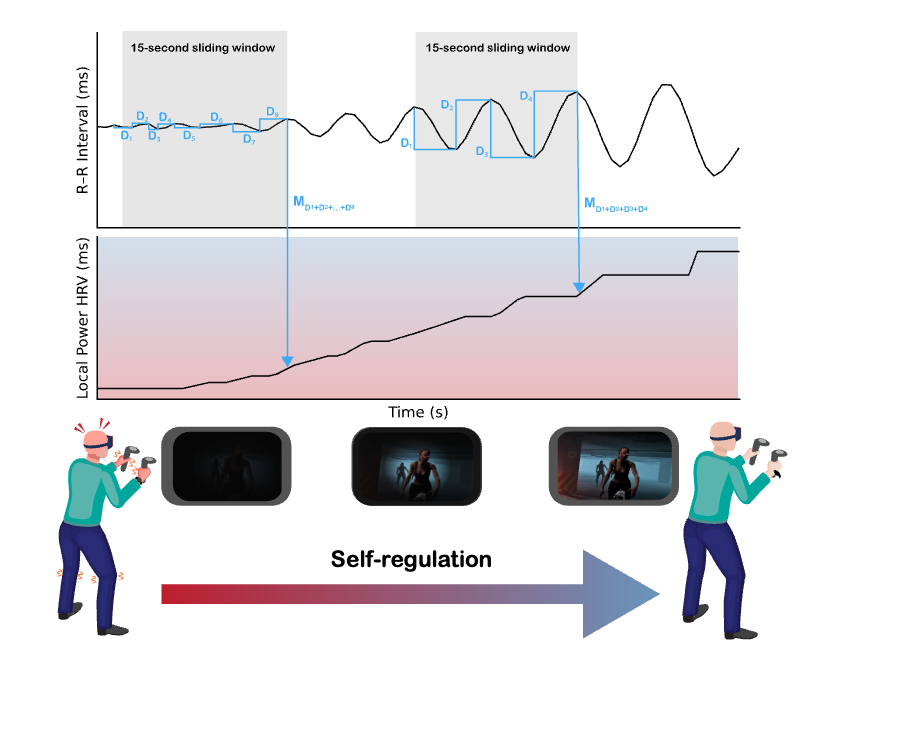
My project explores how crisis-responding police officers Officier van Dienst – Politie (OvD-P) can be trained using biofeedback and reinforcement learning models. The training is called Decision Under Stress Training (DUST). Using virtual reality (VR) technology, participants are placed in a game where they are asked to shoot hostile targets to keep the area safe. When a participant’s heart-rate variability drops, the in-game environment gets darker, acting as negative reinforcement. When heart-rate variability increases, participants are offered positive reinforcement through increased visibility. The goal of the training is to help participants regulate their HRV and rebalance their ANS under stressful situations so they can make better decisions under stress with better executive functioning. This would then increase their psychological resilience, reducing long-term stress-related PTSD symptoms.
Figure 1
Real-time HRV Calculation and In-Game Biofeedback Implementation
How would you explain the relevance of your study to someone unfamiliar with the technical details?
Police officers – especially first responders during crises – frequently encounter adverse work events and must optimally function during such situations. We know that stress-induced arousal impairs decision-making processes that are needed to make judgements during life-threatening situations. While earlier preventive interventions have failed to protect police officers from PTSD symptoms, DUST has proven effective in improving in-game decision making, increasing long-term psychological resilience, and improving stress-regulating abilities. Based on earlier work on how HRV is associated with PTSD symptoms and the efficacy of DUST in increasing HRV in participants, we expect that DUST will equip participants with tools to shield themselves from PTSD symptoms after stressful and life-threatening situations.
Figure 2
Increase in HRV over the Training Sessions
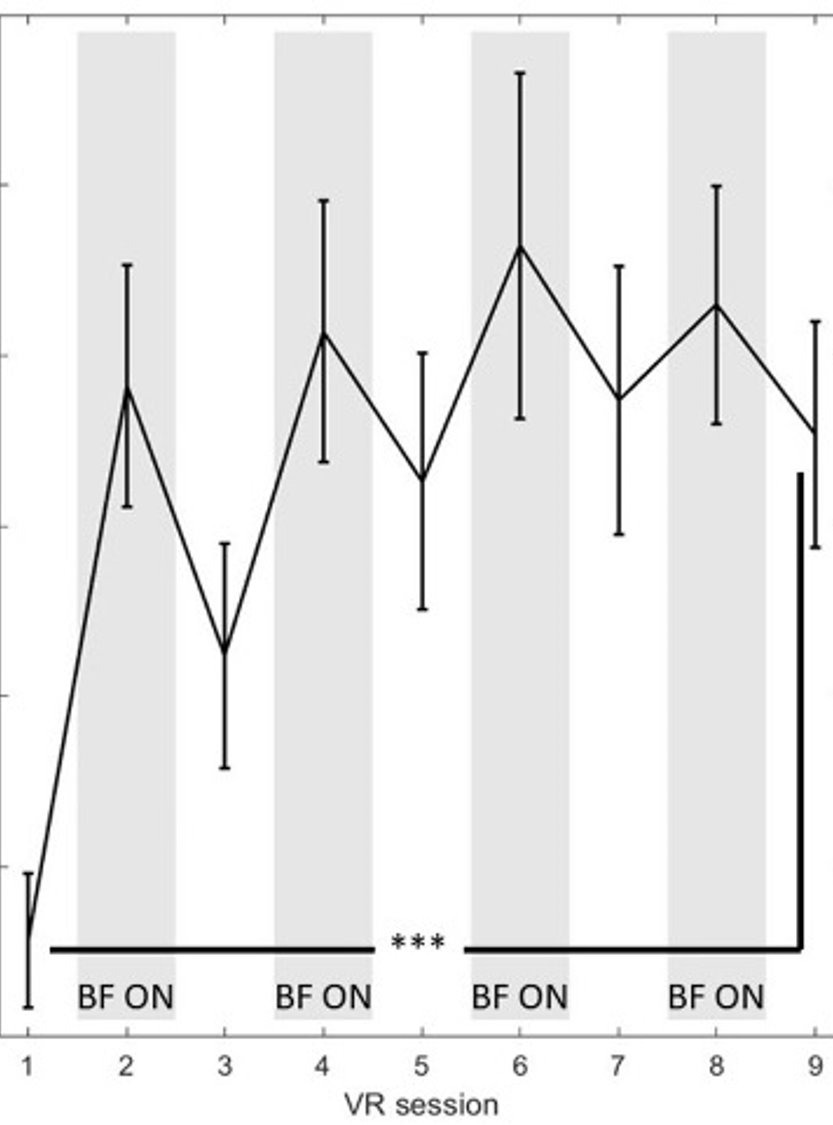
Note. The white bars indicate levels without biofeedback; the gray bars indicate levels with biofeedback. We alternate the presentation of biofeedback to see if the increase in HRV will remain present while biofeedback is absent – as a means to make the transfer effects visible.
Give us a bit of background into your study and how it has developed to this stage.
The game was developed in collaboration with the Dutch Police Academy and has undergone various adaptations throughout data collection to further increase learning potential. For instance, the target HRV – the in-game HRV needed to prevent impaired vision – will scale up to maximise learning for participants with higher HRV at the start and/or greater learning progression throughout the game, and lowered for participants who struggle to achieve the initial target HRV. Training protocols for trainers present at data collection have been continuously updated using latest insights and finding solutions for encountered challenges. Earlier versions of DUST allowed only one participant to be trained at a given moment, the new setup allows up to six participants to be trained simultaneously.
Why did you choose this project?
Firstly, I thought this project was right up my alley. For my previous master’s, Clinical Psychology at Utrecht Universiteit, I was interning at a PTSD clinic. Given how this study aims to shield police officers from the onset of PTSD symptoms after trauma exposure, I thought that this study would be a nice addition to my previous experience. Secondly, the societal relevance was also very clear to me, and I really hope that through this study, even if it is just a little bit, I can help alleviate consequences of adverse work events. Thirdly, I wanted to collaborate with Floris Klumpers because I felt aligned with his personality and methodological approach and I have really enjoyed working with him so far!
Who are you working with and what have you learnt so far about collaborating on a project like this?
So far, I have collaborated with the Experimental Psychopathology and Affective Neuroscience group with Karin Roelofs as PI In the DUST team, I am working with another RMBS student, Jonathan Posthuma (PhD candidate), Teun-Pieter de Snoo (external PhD candidate) Jacobien van Peer (assistant professor), Floris Klumpers (associate professor), and Karin Roelofs (full professor). I have improved my time management, making neat and comprehensible plots, learnt to accept edits, and learnt to dare to ask questions that might be ‘elementary’ or ‘redundant.’ Finally, I am still learning to manage work-life balance and communicate in a timely manner because this also has consequences for others.
What are some scientific insights you’ve gathered so far that have surprised you or taught you something new or interesting?
One of the things that really stands out to me is the sheer amount of adverse work events that OvD-P officers encounter on average. These people sometimes have up to 20 negative work events (e.g., being involved in a shooting incident) in just three months! Another thing is how effective DUST is in training the upregulation of HRV; all participants playing with DUST show significant improvement. This is really interesting to see. Finally, preliminary results indicate that DUST does have a shielding effect. There is lower PTSD symptomatology in post-DUST events compared to events only experienced prior to DUST. This really motivates me to keep on working on this project!
What has been your favourite part of the project?
One of my favourite parts of this project has been that I can shadow the OvD-P during the scenario training. Assisting on a project that helps them to be better OvD-P officers and helps to prevent drop-out at work is very inspiring!